



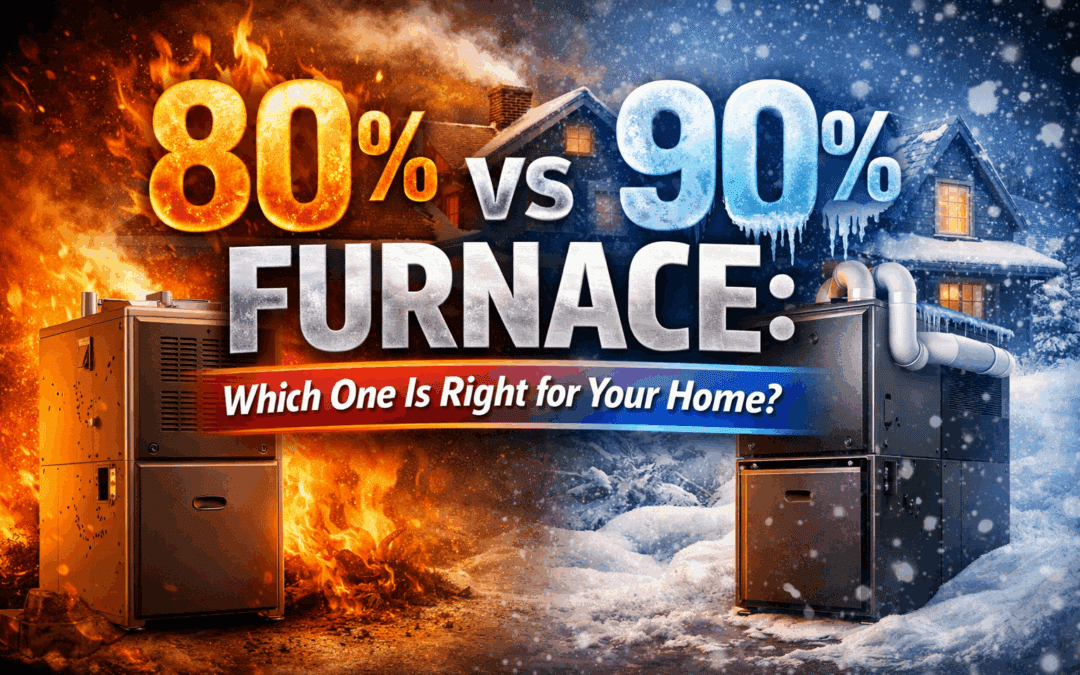
80% vs 90% Furnace: What’s the Difference and Which One Should You Buy?
If you’re replacing a furnace, you’ll likely hear two options right away: an 80% furnace or a 90% (or higher) furnace. And the question usually comes fast:
“Is the 90% model worth it?”
The answer depends on your home, your comfort goals, and how long you plan to stay put—but once you understand what these numbers mean, the decision gets much easier. In this guide, we’ll break it down in plain English, highlight the real-world comfort and efficiency differences, and help you avoid one of the most common HVAC replacement mistakes homeowners make.
What Do “80%” and “90%” Mean on a Furnace?
Furnace efficiency is commonly measured using AFUE, which stands for Annual Fuel Utilization Efficiency. AFUE describes how efficiently a furnace converts fuel into usable heat over the course of a typical year.
- 80% AFUE furnace: roughly 80% of the fuel you pay for becomes heat in your home, and about 20%
is lost (mostly through the exhaust). - 90%+ AFUE furnace: roughly 90% (or more) becomes usable heat, and a smaller portion is lost.
Think of it like this: AFUE isn’t just a label—it’s a clue about how much heat you’re buying versus how much heat you’re actually getting.
What Is an 80% Furnace?
An 80% furnace is considered a “standard efficiency” furnace. These systems typically vent through a metal flue (often a chimney or a dedicated exhaust vent) and operate without condensing technology.
Pros of an 80% furnace
- Lower upfront cost in many installations
- Simpler venting in some existing setups
- Proven, straightforward design when properly sized and installed
Potential downsides
- Higher operating costs compared to a higher-efficiency system
- Less efficient heat delivery—more fuel is “lost” through venting
- In many homes, homeowners may notice more cycling and less even temperature control depending
on ducting, insulation, and sizing
An 80% furnace can still be a reasonable choice in certain scenarios—but it should be chosen intentionally, not by default.
What Is a 90% Furnace (and Why Is It More Efficient)?
A 90%+ furnace is generally a “high efficiency” furnace. These are often condensing furnaces, meaning they capture and reuse more heat from the combustion process before exhausting air outdoors.
Pros of a 90%+ furnace
- Lower heating costs over time (especially if you use your heater frequently)
- More heat stays in your home instead of exiting through the exhaust
- Many homeowners experience more consistent comfort when the system is properly sized, ducted,
and installed
Considerations
- Higher upfront investment in many cases
- Installation requirements can be different than an 80% furnace (venting approach, placement,
and configuration)
If you’re the kind of homeowner who plans to stay in your home for years, prefers steadier comfort, and wants to reduce waste, a 90%+ furnace is often worth a serious look.
80% vs 90% Furnace Costs: What Homeowners Should Compare
It’s tempting to focus only on purchase price. But with heating equipment, the best comparison is typically:
upfront cost versus long-term operating cost.
Upfront cost
In many homes, an 80% furnace can be less expensive to install—especially if the venting and layout already match the equipment. A 90%+ furnace may require a different venting configuration and more installation planning.
Long-term cost
Over time, the higher efficiency of a 90%+ furnace can reduce fuel waste and lower heating costs. The amount you save depends on your heating habits, the size of your home, insulation quality, duct conditions, and how cold your household prefers to keep it.
The key is not chasing “the cheapest furnace.” The key is choosing the furnace that delivers the best total value for your specific home.
Comfort Differences You’ll Actually Feel
Homeowners often assume efficiency only affects utility bills—but comfort is a huge part of the conversation. Depending on your system design and home conditions, the right efficiency choice can impact:
- Temperature consistency: fewer hot/cold swings
- How quickly rooms warm up
- How evenly heat is distributed across the home
- Noise and cycling behavior (varies by system type and install quality)
A properly designed system is the real comfort-maker. Efficiency is part of the equation—but so are ducting, airflow, sizing, and thermostat control.
Northern California Considerations: Sacramento Area Heating Reality
In Northern California—Sacramento, Placer County, Yuba-Sutter, and surrounding areas—winter temperatures can fluctuate. Some seasons are mild, while others bring long cold stretches where your system runs more often.
That’s why we typically look at a few practical factors before recommending an 80% vs 90% furnace:
- How often you heat: daily use vs occasional use
- Home layout: open floor plan vs many separate rooms
- Insulation and windows: heat retention plays a big role in comfort and cost
- Duct condition: leaks and poor airflow can erase efficiency gains
- Long-term plans: staying 2 years vs staying 10+ years
When you match the right equipment to the home, you get better comfort, fewer surprises, and a system that performs the way it’s supposed to.
The Common Replacement Mistake: A “Mismatched” HVAC System
Here’s a situation we see more often than homeowners realize: someone replaces part of their HVAC system, but the overall system becomes mismatched—especially when upgrading cooling equipment while keeping (or installing) a lower efficiency furnace.
For example, some homeowners end up with a newer, higher-efficiency air conditioner paired with an older or lower
efficiency furnace. The result can be:
- Less comfort than expected
- Higher operating costs than the homeowner planned for
- A system that doesn’t feel “like an upgrade” even after spending good money
The best approach is to evaluate the system as a whole—heating, airflow, ducting, and control strategy—so the investment actually delivers what you’re paying for.
So… Which One Should You Choose?
If you want a simple decision framework, here’s a helpful way to think about it:
An 80% furnace may make sense if:
- You’re working within a tighter upfront budget
- Your home’s setup strongly favors standard venting and a straightforward replacement
- You heat less frequently and don’t expect long daily run times
A 90%+ furnace may make sense if:
- You want lower energy waste and better long-term value
- You care about steadier comfort and performance
- You plan to stay in the home long enough to benefit from the efficiency gains
Ultimately, the best choice comes down to how your home is built, how you use your HVAC system, and what you value most: lowest upfront cost or strongest long-term performance.
Local Expertise Matters: Why Homeowners Choose Alpine Heating & Air Conditioning
For over 35 years, Alpine Heating & Air Conditioning has helped homeowners and businesses across El Dorado, Placer, Sacramento, Sutter, and Yuba Counties make confident heating and HVAC decisions—without pressure and without guesswork.
If you’re comparing furnace options, the most important step is a professional evaluation that considers the entire system—not just a model number.
Learn more about our heating services here: Heating Services
and explore full-service support here: General HVAC Services.
If comfort varies from room to room, zoning can be a game-changer. See: HVAC Zoning.
Call (916) 850-9700 to schedule a no-pressure evaluation or request a free estimate.
Frequently Asked Questions
Is a 90% furnace worth the extra cost?
Often, yes—especially if you heat your home frequently, plan to stay put for several years, and want better long-term value. The real answer depends on your home’s layout, insulation, ducting, and comfort goals.
How much can I save with a higher-efficiency furnace?
Savings vary based on fuel costs, how often your system runs, and how well your home retains heat. In many homes, a 90%+ furnace can reduce waste and lower heating costs over time, but the best way to estimate savings is a home-specific evaluation.
Does a 90% furnace heat my home better than an 80% furnace?
Efficiency affects how much fuel becomes usable heat, but comfort also depends heavily on correct sizing, airflow, duct condition, and thermostat control. A well-designed system is what delivers the biggest comfort improvement.
Why does “system matching” matter when replacing HVAC equipment?
HVAC equipment works best when heating, airflow, ducting, and controls are designed to work together. When part of the system is upgraded without considering the rest, homeowners can end up with less comfort and weaker overall value.
Can zoning help if some rooms are always colder than others?
Yes. Zoning can help balance temperatures across different parts of your home by controlling airflow more precisely. If you have hot/cold spots, zoning may be worth discussing during your evaluation.
How do I know what furnace size my home needs?
Furnace sizing should be based on a proper load calculation that considers your home’s square footage, insulation, windows, layout, and local climate. Oversizing or undersizing can cause comfort problems and efficiency losses.
